Agile
strategies for retail supply chain Management
As a result of the effects of change and
globalization, companies are attempting to build and sustain their edge over
competitors in a multitude of sectors. This scenario illustrates their
effectiveness and efficiency in utilizing the resources available to them. The
notion that the supply chain encompasses the complete manufacturing,
distribution, and even recycling of a product, as well as the reality that
efficient supply chain management signals effective corporate performance, has
piqued interest in the supply chain. Companies must continually assess their
supply chain architecture since it must be flexible, rapid, and timely in order
to make the appropriate changes in the industrial environment. Agility
is a concept that is widely discussed in scholarly communities and in
management practices and guidelines of its interaction with the supply chain.
It was originally developed at the stage of selecting the right strategic plan
in line with the requirements of the moment. The necessity for an innovative
supply chain system is highlighted by the global expansion of activity areas,
the uncertain industrial environment, and consumer demands. In this context, an
agile supply chain provides organizations with the ability to adapt to
unforeseen occurrences both inside and outside the company. The agile supply
chain has now been analysed in terms of the requirements of an integrated
supply chain in managing uncertainty as well as its beneficial benefits for the
performance of the organization as a system in several roles. First, using
research on the agile supply chain, a conceptual framework was created, and the
aspects that build the foundation for the agile supply chain were presented.
Following that, the elements that influence the choice of an agile supply chain
within the context of product and market expectations were discussed. Within
the scope of the research and reports, the beneficial effects they have had on
business are summarized. Based on an assessment of the supply chains used by
businesses, it is determined that agile supply chain applications are critical
for long-term competitive advantage (Ruffle and Saradar, 2013).
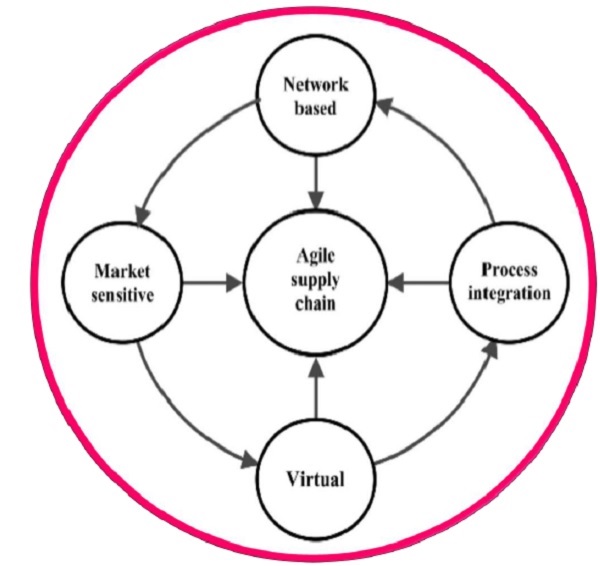
supply
networks are growing more complex, and managing this complexity in order to
ensure effective responsiveness necessitates more sophisticated data
processing. In this respect, technological advancement (IT) is a tool that
helps to digitalize and/or create information systems procedures at the SC
level in order to gain a competitive edge via responsiveness. As a result, both
LSC and ASC may be supported by IT because they are strategies connected to
SC's response capabilities, delivering leanness or agility, respectively. As
such, major innovations in the IT solutions that can be applied to SC, as well
as changes in demand that necessitate very flexible responses, have attracted
the attention of business executives in the IT-flexibility relationship,
prompting researchers to examine the existing relationship between IT and
flexibility (Rahimi Nezhad Galan Kashi and Helmi, 2016).
The agile
supply chain prioritizes speed, response, cost effectiveness, flexibility, and
increased product and service production. Agile organizations provide greater
service standards with reduced inventory, so this sector has received a lot of
attention in the industrial and service industries during the last two decades.
This research report presents a
bibliometric survey of the literature on agile supply chains in the industrial
and service industries. It gathers information from a variety of publications,
companies, and regions to create a map of prior study on this topic. Using a
variety of approaches, the study shows how adaptable supply chain research has
evolved over the past few decades. Diverse visualization methods have been used
to examine highly significant authors, organizations, and keywords. Important
publications, citations, and a network of co-citations have been included in
the study. The main objective of this study is to present the efficiency of the
Agile strategies for retail supply chain management (Martin and Twill, 2000) .
1. Background
1.1 Key
issues and their conceptualization
In
developing brand reputation and establishing competitiveness in the global
market, supply chain management plays a significant role. Supply chain
management methods are one-of-a-kind and unrivalled. Effective supply chain
management methods usually boost organizations' revenue by reacting well to
consumers' requests as well as building rapport and dependability across
enterprises for improved customer delivery. Customers' demands are increasing
as the market expands from a domestic to a worldwide level, particularly in
terms of lower-cost items, faster delivery, improved quality, and the quantity
of product assortments. This necessitates backing for efficient supply chain
management, which may enhance value, efficiency, and customer satisfaction. As
a result, the marketability of items is determined. Industry leaders,
policymakers, educators, and researchers are all concerned and interested in
supply chain management in the present market conditions. This is because the
area encompasses a wide spectrum of operations, ranging from procurement and
manufacturing to consumer products, and it has become the primary instrument
used by businesses to gain a competitive advantage in the market. Due to its
essential position of "location" in the "demographic segmentation"
marketing mix idea, it is becoming a key aspect in surviving in today's
corporate situations. Supply chain management is the sole aspect of the market
that is particularly tough to mimic when compared to other notions. Supply
chain management necessitates a firm's connection with its suppliers being
extended (Moynihan and Dai, 2011).
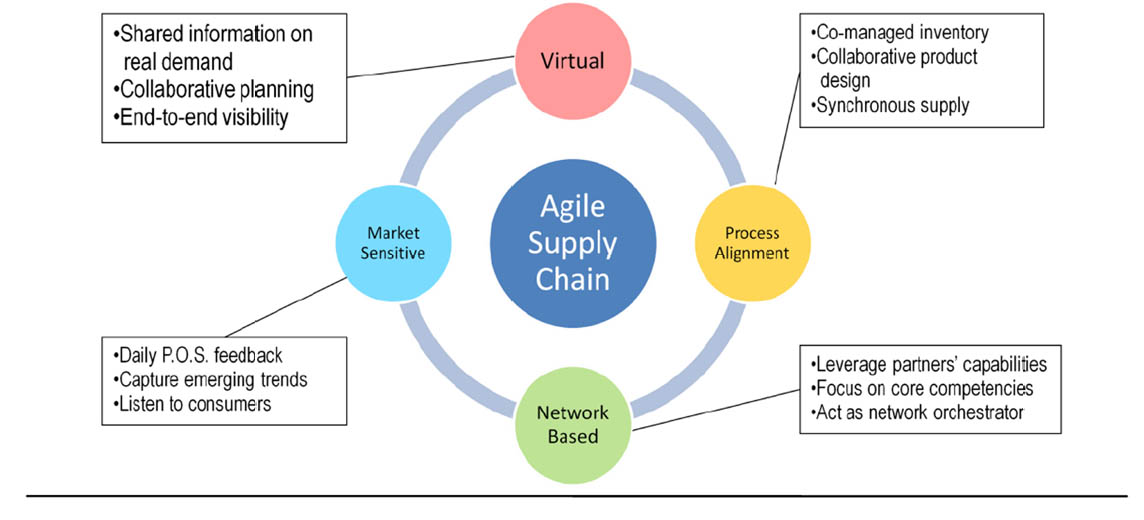
Fig2:
link between agile strategies and Competitiveness source: ResearchGate
Some
key issues related to supply chain management-
· Customer
expectation management is one of the most difficult aspects of supply chain
management. Service providers are supply chain managers. They also help with
indirect procurement, project and production demands, as well as requests
coming from external customers. As a result, supply chain managers must
implement effective procedures to ensure that commitments are met on time,
every time.
·
Along with managing consumer expectations,
suppliers must also be managed. To properly manage the supply chain, one must
have good connections with the suppliers. For resolving this issue real time
data on timely basis is highly required.
· Concerns
regarding the quality and sustainability of products manufactured in other
locations are amongst the issues of the international supply chain network.
This is especially true when product components must full-fill regulatory
requirements.
·
Access to your supply chain data is one of the
most crucial criteria in today's modern supply chain. Data access can assist in
a more effective supply chain. Without this, you won't be able to make informed
changes to your supply chain or reduce risks.
·
Risk mitigation is difficult for any supply
chain management organization. Whereas risk is a broad concept, supply chain
managers should be aware of a few key supply chain concerns (Martin and Twill,
2000).
1.2 Supply chain modules with strategies
|
S.no |
Module |
Strategy |
|
1 |
Production Management |
Production
management is the process of overseeing a company's actions in order to
provide the required products and services. Planning, executing, and
directing activities to turn raw resources into completed goods and services
are all part of it.
|
|
2 |
Inventory management |
The process of ordering,
storing, using, and selling a company's inventory is referred to as inventory
management. This involves the storage and processing of raw materials,
components, and completed goods, as well as the administration of raw
materials, modules, and final products. |
|
3 |
Location Management |
The process of determining
a person's physical location so that calls directed to that user can be
routed to that place is known as location management. Location management is
also in charge of ensuring that users accessing the network are genuine. |
|
4 |
Transportation Management |
As part of supply chain or
logistics management, transportation management encompasses the systems and
procedures used to manage the requirements and demands relating to the
physical movement of products and cargo. |
|
5 |
Information Management |
Throughout the information
life cycle, information management is a wide phrase that encompasses rules
and processes for centrally controlling and distributing information across
many persons, organizations, and/or information systems. Information asset
management is another term for information management. |
|
6 |
Requirement Management |
The goal of requirements
management is to make sure that product development objectives are
accomplished. It's a collection of procedures for documenting, evaluating,
prioritizing, and agreeing on requirements so that engineering teams have the
most up-to-date and authorized requirements at all times. |
|
7 |
Quality management |
The act of managing all
activities and duties required to achieve a specified degree of efficiency is
known as quality management. Quality management includes establishing a
quality strategy, developing and executing quality assurance and planning, as
well as quality control and quality improvement. |
|
8 |
Customer management |
Customer management is
referred to as the process of managing an organization's, people's, and
customers' relationships across time. |
|
9 |
Stock Management |
The technique of ordering,
storing, managing, and regulating goods is known as stock management. From
raw materials to completed items, stock management relates to everything a
company employs to make its products or services. |
|
10 |
vendor |
Vendor management is the
process that enables a company to take necessary steps to control costs,
reduce possible vendor risks, ensure outstanding service delivery, and get
long-term value from suppliers. |
(Rahimi
Nezhad Galan Kashi and Helmi, 2016)
2.3 Application of agile strategies for retail
supply chain management
Adaptability is a priority in agile supply chain management. It's for businesses that need to respond rapidly to shifting circumstances. This strategy made it easier to adapt sourcing, logistics, and sales in response to economic fluctuations, technological advancements, and client demands. Before ending manufacturing, an agile supply chain usually waits to see what the market demand is. Corporations may use short-term estimates to help them stay flexible, but one of the most important aspects of agile supply chains is that they adjust to demand as it occurs. This method is ideal for generating goods that are constantly changing and adaptable, like clothing. The agile supply chain emphasizes adaptability and responsiveness. It adjusts to changes in the marketplace, client preferences, and business quickly. It's designed to deal with market volatility by "postponing" manufacturing and waiting to see what the market says before proceeding. An agile supply chain waits to see how much demand there is before generating the final product, allowing it to react immediately to demand rather than predict it. Some market forecasting is still required as several parts of a product are generated ahead of time to make the finalization process swift and efficient (Hamdani et al., 2022).


No comments:
Post a Comment